In an effort to set up a community around adiabatic and reversible computing, we are asking participants in Rebooting Computing that are knowledgeable about this topic to post references to explanatory material.
We request that people posting technical materials make themselves available to explain the material or to participate in a dialog.
Saturday, March 22, 2014

Thursday, March 20, 2014
RCS 2 organizational comments
The following points were discussed by the organizing committee.
Rebooting Computing participants are asked to find future technology options in an expansive way. There is a lot of precedent for identifying technology options that are subjectively or quantitatively better than current technology. However, Rebooting Computing encourages participants to look further. First, the current technology (CMOS, or Moore's Law) will continue to advance for some time. Technology options should be compared against the endpoint of road maps rather than current products. Furthermore, there are multiple radical technologies under consideration. It will be important to see how the forward-looking technologies stack up against each other.

RCS 2 is viewing applications as the driver for technology requirements. The committee is proposing three applications classes:
- Mobile computing
- Learning and reasoning, based on the "executive assistant" from RCS 1
- Servers and supercomputers
- Neuromorphic, or brain inspired
- Incremental improvements on CMOS
- Adiabatic and Reversible
- Approximate computing

(*NLP = Natural Language Processing; *CNT = Carbon Nanotube; *JJ = Josephson Junction)
The organizing committee discussed the following timeline:
Pre-RCS 2: The blog and website will be seeded with information about Rebooting Computing. Also, some participants will be encouraged to create summary information of technology areas. These will provide context for the program at the RCS 2 event.
At RCS 2: Participants will be encouraged to form groups around self-consistent technology ideas. For example, people advocating a hardware technology in conjunction with people interested in a specific aspect of the applications.
Over summer 2014: Participants will be encouraged to maintain a persistent involvement through the website, blog, e-mail, and personal interactions.
At RCS 3, around October 2014: The goal of this event will be to enable participants to offer "rebooted computing" ideas in forum of people that can appreciate the ideas, including contrasting multiple approaches to computing.
Wednesday, January 29, 2014
competition for energy-efficient computing (image recognition)
This figure shows the idea of the competition. The inputs will be a set of images. The score is the ratio of the accuracy and the amount of energy consumed. The participants have the freedom to offload computation.
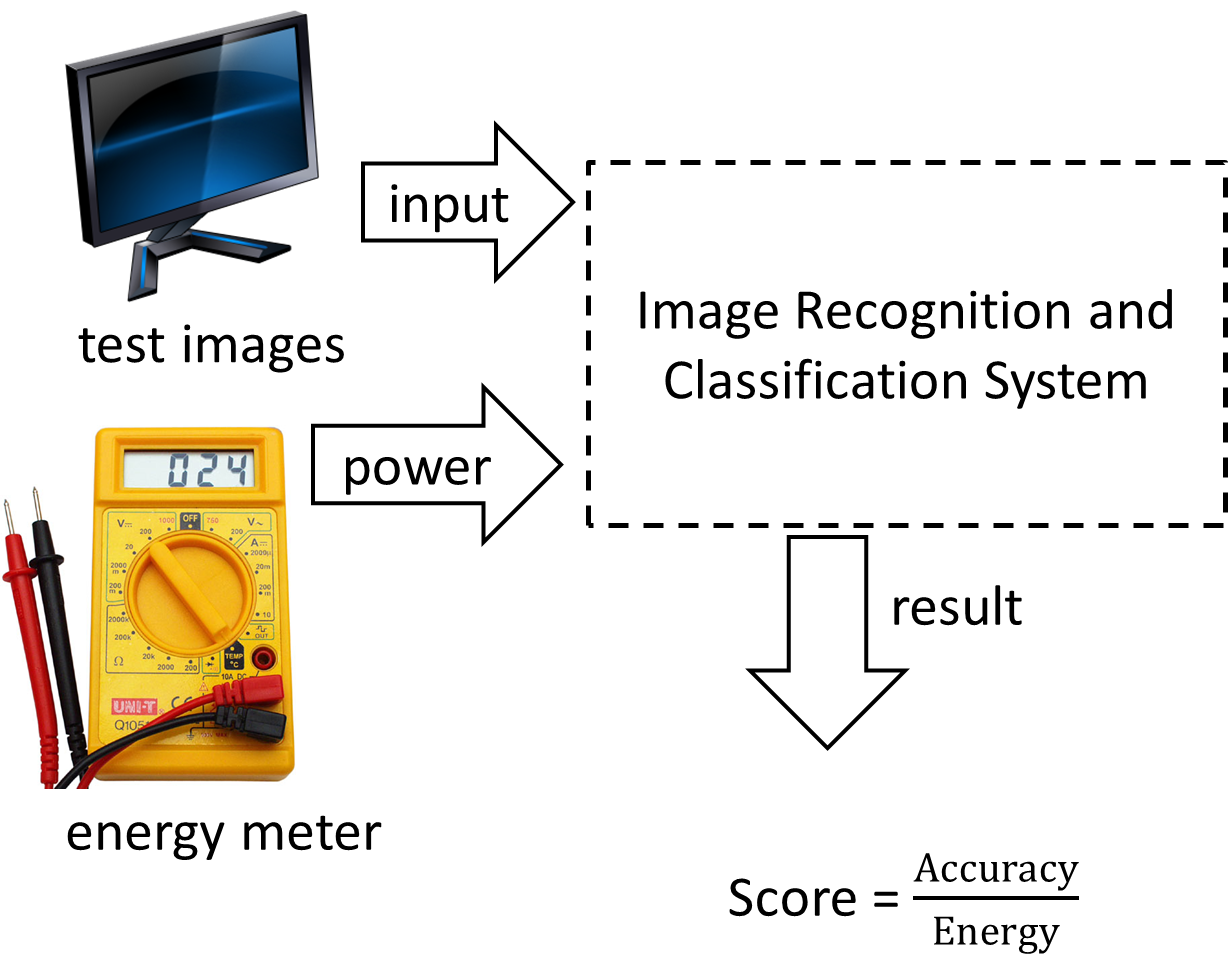
The competition will be held in 2015 with a major conference (one candidate is IEEE International Symposium on Circuits and Systems in June). The winner must be able to recognize or classify at least half of the images (i.e. the accuracy must exceed 50%).
Prizes:
The competition will be held in 2015 with a major conference (one candidate is IEEE International Symposium on Circuits and Systems in June). The winner must be able to recognize or classify at least half of the images (i.e. the accuracy must exceed 50%).
Prizes:
- first prize is a cash award of USD$5,000
- second prize $3,000
- third $2,000.
Tuesday, January 28, 2014
questions for energy efficiency in Rebooting Computing 2
Hello, Everyone,
The RC (rebooting computing) committee gave me the tasks of writing a
set of questions to discuss for the blogger as well as the next RC
Summit. Here is my first attempt. Please feel free to comment and
change the list. Thank you.
What technologies have the potential replacing CMOS? Where are they
standing now? What are the likely timelines?
Will Boolean logic be replaced? What are the candidates?
Will future computers be hybrid, including some parts that can produce
precise answers (number crunching) and some parts that produce
approximate answers (such as recognition)?
Will it be possible to power most of the "edge devices" (sensors,
mobile phones, tablets) by ambient energy sources? If so, how? If
not, why?
What is the theoretical minimum energy for computing, communication,
and storage?
Let me further define the units of computing, communication,
and storage.
One unit for computing is one double-precision floating-point
division.
One unit of communication is sending 1MB and receiving 1MB data
(excluding headers) for wireless: 10 meters away; for wires or fiber:
100 meters away.
One unit of storage is saving 1MB data (without metadata).
What is the state of the art in the energy consumption for computing,
communication, and storage?
What is the distance between the theoretically minimum and the current
state of the art?
What are the barriers reducing the distances?
How are different power management solutions evaluated? Do you think
future electronics should have "energy counters" that can report their
energy consumption? Would this accelerate the research and innovation
improving energy efficiency?
Is it possible to develop "energy benchmarks" (similar to performance
benchmarks)? As most computing devices are connected to networks,
would it be necessary to develop energy benchmarks that consider
network connections? How should the energy consumed by shared
resources (routers and servers) be counted?
Thursday, January 16, 2014
Action Items for energy efficiency
From the summit, I think there are two main actions items for the energy efficiency group.
- Organize a competition of low-power designs.
- Organize workshops discussing how to design systems that can migrate computation to more energy efficient locations or locations with renewable energy
Wednesday, December 18, 2013
competition held with a large conference?
If the competition is held with a large conference, we can naturally get a large audience. Which conference should we choose? Two conferences come to my mind: International Symposium on Circuits and Systems and Design Automation Conference. Please feel free to suggest another conference.
I think 2014 is too close and 2015 is more reasonable. What do you think?
I think 2014 is too close and 2015 is more reasonable. What do you think?
preliminary ideas for a competition of low power
I think the competition should be at the system level, something most
people can understand. This can create more excitement and wider participation, like what Deep
Blue and Watson did. If it is low-level, such as "being able to use only 1e-20J doing double-precision floating-point division", most people will not understand.
These are some preliminary ideas:
We can create some types of "recognition-based benchmarks". For example, give 1,000 + 1 images. Among the 1,000 images, one of them is the closest to that particular image. The "closest" will be defined by a committee but should be commonly agreed by most people. If 1,000 are too few, we can easily increase that to much more. ILSVRC (http://www.image-net.org/challenges/LSVRC/2013/#data) has a lot of images.
The participants are divided into two groups:
We may further divide the groups to
These are some preliminary ideas:
We can create some types of "recognition-based benchmarks". For example, give 1,000 + 1 images. Among the 1,000 images, one of them is the closest to that particular image. The "closest" will be defined by a committee but should be commonly agreed by most people. If 1,000 are too few, we can easily increase that to much more. ILSVRC (http://www.image-net.org/challenges/LSVRC/2013/#data) has a lot of images.
The participants are divided into two groups:
- customer hardware
- commodity hardware.
We may further divide the groups to
- with network connections (can offload computation).
- without network connections (cannot offload computation).
Subscribe to:
Posts (Atom)